EMOTIONAL EATING: THE QUIET PATTERN NO ONE TALKS ABOUT
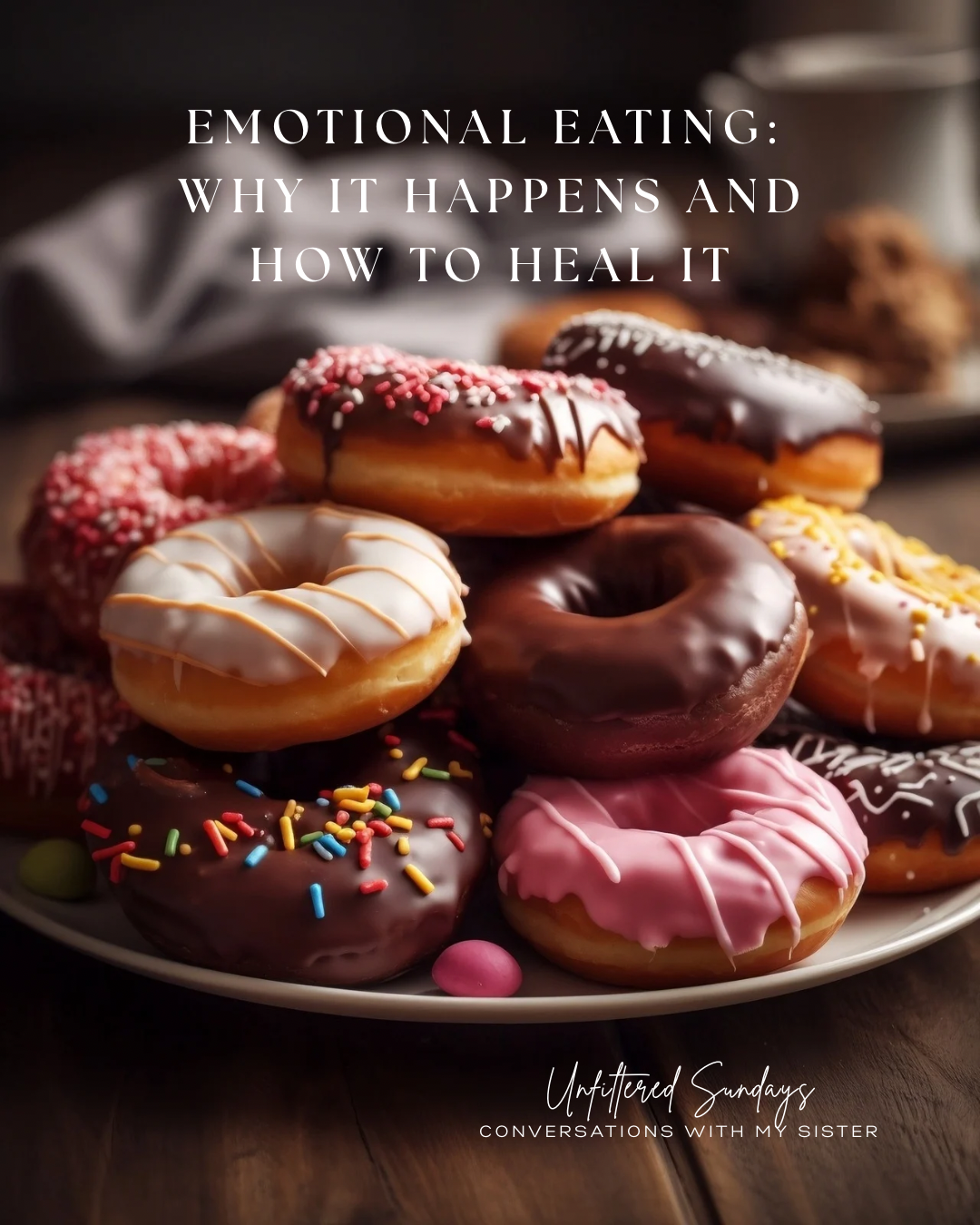
I don’t think we talk enough about emotional eating.
Not the jokes. Not the “I need chocolate” memes.
The real thing.
The quiet thing.
The thing women carry in silence because it feels too personal, too shameful, too hard to explain.
I’ve battled eating disorders since I was 13.
Thirteen.
And emotional eating was the last part to heal — because it’s the most invisible.
It doesn’t look dramatic.
It doesn’t look dangerous.
It looks “normal.”
But deep down, there is nothing normal about using food to soothe pain you don’t know how to face.
And I’ll say it the way I’ve always felt it:
Emotional eating is a form of addiction — just one we don’t name, don’t recognize, and don’t treat with the compassion it deserves.
Not because you’re weak.
Not because you “can’t control yourself.”
But because your mind is trying to protect you in the only way it learned how.
WHAT EMOTIONAL EATING REALLY IS
It took me years to understand this:
Emotional eating has nothing to do with hunger.
It has everything to do with safety.
Food becomes the thing you reach for when your heart feels too full,
or your mind feels too loud,
or your nervous system is overwhelmed and doesn’t know where to put all that energy.
It becomes:
• pause
• a distraction
• a sedative
• a break from yourself
• a moment of comfort
• a moment of silence
• a way to avoid what you’re not ready to feel
• a coping strategy your younger self created to survive
Women learn this young.
Some of us learn it in childhood, some in adolescence, some during trauma, heartbreak,
loneliness, stress, or years of trying to be everything for everyone.
It’s never random.
It’s never meaningless.
There is always a reason.
WHY IT FEELS LIKE AN ADDICTION
Because it is an addiction in the way the brain experiences it.
Your body feels discomfort → your mind wants relief → food gives a quick hit of comfort → the cycle reinforces itself.
But unlike other addictions, this one is socially accepted.
It hides inside everyday life.
You can do it in public and no one notices.
You can do it at home and tell yourself it’s “just a snack.”
You can do it for years without realizing you’re trying to soothe emotions, not hunger.
And because women carry so much — stress, grief, exhaustion, responsibility, expectations — food becomes the one place where the world quiets down.
Even if it’s just for a moment.
THE PART NO ONE EXPLAINS
The moment you understand why emotional eating happens...
everything softens.
You stop making it about willpower.
You stop thinking something is wrong with you.
You stop punishing yourself for not being “disciplined.”
Emotional eating is not a character flaw.
It’s an emotional regulation tool.
Just one that no longer serves you.
That’s where the real healing begins.
HOW THE PATTERN BREAKS (GENTLY, NOT FORCEFULLY)
Healing emotional eating isn’t about dieting, restricting, or fighting yourself.
It’s about learning how to meet the emotion underneath the urge.
Here’s what actually changes the pattern:
1. NOTICE THE URGE WITHOUT JUDGING IT
This sounds simple, but it’s the most powerful step.
The moment you pause and think,
“Something inside me needs attention,”
you shift out of the autopilot pattern.
This alone rewires everything.
2. NAME THE FEELING UNDERNEATH
Loneliness.
Stress.
Sadness.
Anger.
Boredom.
Overwhelm.
Fear.
Numbness.
Disappointment.
When you name a feeling, it loses its power over you.
Your body relaxes.
Your nervous system stabilizes.
Your mind stops spiraling.
Naming is regulating.
3. ASK YOURSELF WHAT YOU ACTUALLY NEED
This is the moment the pattern breaks open.
Often the answer has nothing to do with food, and everything to do with:
• rest
• comfort
• connection
• a moment alone
• a deep breath
• grounding
• sleep
• support
• movement
• fresh air
When you meet the real need, the urge dissolves.
4. GIVE YOURSELF THAT NEED IN A NEW WAY
This is where you reteach your mind a new path.
A healthier one.
A kinder one.
It can be small:
• stepping outside for fresh air
• putting your hand on your heart
• drinking water
• stretching
• journaling for 2 minutes
• a warm shower
• calling someone you trust
• lying down for 5 minutes
• sitting in silence
These tiny alternate pathways are what break the addiction-like cycle.
They tell your nervous system:
“You are safe. I’m here. I’m listening.”
5. AND IF YOU STILL EAT? YOU ARE NOT FAILING
You are learning.
You are building awareness.
You are breaking years — sometimes decades — of conditioning.
Healing is not linear.
Awareness is the healing.
Every moment you pause, every moment you name a feeling, every moment you ask what you truly need...
you’re giving yourself something emotional eating never could:
choice.
WHAT HAPPENS WHEN YOU FINALLY FEEL SAFE
This is the part no one talks about:
When your body feels safe,
the urge to emotionally eat quiets on its own.
Not because you force it.
Not because you fight it.
Not because you starve it out.
But because your nervous system no longer needs it.
Your body learns:
“I can feel my emotions.
I can hold them.
I can comfort myself in ways that don’t hurt me.”
And the younger version of you — the one who began this pattern — finally gets what she always needed:
support, compassion, and safety.
YOU ARE NOT BROKEN
If emotional eating has been part of your story,
you need to hear this:
You’re not broken.
You’re not weak.
You’re not out of control.
You’re not a failure.
You’re a woman who built an emotional survival strategy at a time when she didn’t have better tools.
Now you do.
And you can rewrite the pattern — gently, compassionately, and without shame.
Because emotional eating isn’t a flaw.
It’s a message.
And once you learn how to hear it...
you’re finally free.